How to pass a prop firm challenge: limits, rules and the mistakes that fail it
How to pass a prop firm challenge (FTMO, FundedNext and others): daily and max drawdown, phase targets, risk per trade and 9 mistakes that fail most traders.
Contents
- What is a prop firm challenge
- Prop firm challenge rules: FTMO, FundedNext and the usual terms
- Daily and max drawdown: how they're calculated
- How much to risk per trade in a challenge
- What share of traders pass a prop firm challenge
- 9 mistakes that fail prop firm challenges
- A step-by-step plan to pass a prop firm challenge
- How a trading journal helps you pass
- FAQ
A prop firm challenge is a paid evaluation in which you trade the firm's capital under strict rules: hit a profit target (usually 8–10% in phase 1 and 5% in phase 2) without ever breaking the daily loss limit (most often 5%) or the max loss limit (most often 10%). The target itself is modest. Most traders fail on the limits instead: oversized risk per trade, floating losses that touch the daily floor, and revenge trading after a loss.
Below: how a challenge works, the rules at FTMO, FundedNext and other firms, how daily and max drawdown are calculated, how much to risk per trade, and a plan that gets you through.
What is a prop firm challenge#
A prop firm (short for proprietary trading firm) lets traders trade its capital and shares the profit with them. To get such an account, a trader buys a challenge, also called an evaluation, and proves they can trade profitably without taking reckless risk.
The usual path has three stages:
- Phase 1, the challenge. Make the profit target, usually 8–10% of the starting balance, over a minimum number of trading days.
- Phase 2, the verification. The same test with a smaller target, usually 5%, to confirm phase 1 wasn't luck.
- Funded account. No target any more, the limits stay. Profit is split between trader and firm, with the trader typically keeping 80–90%.
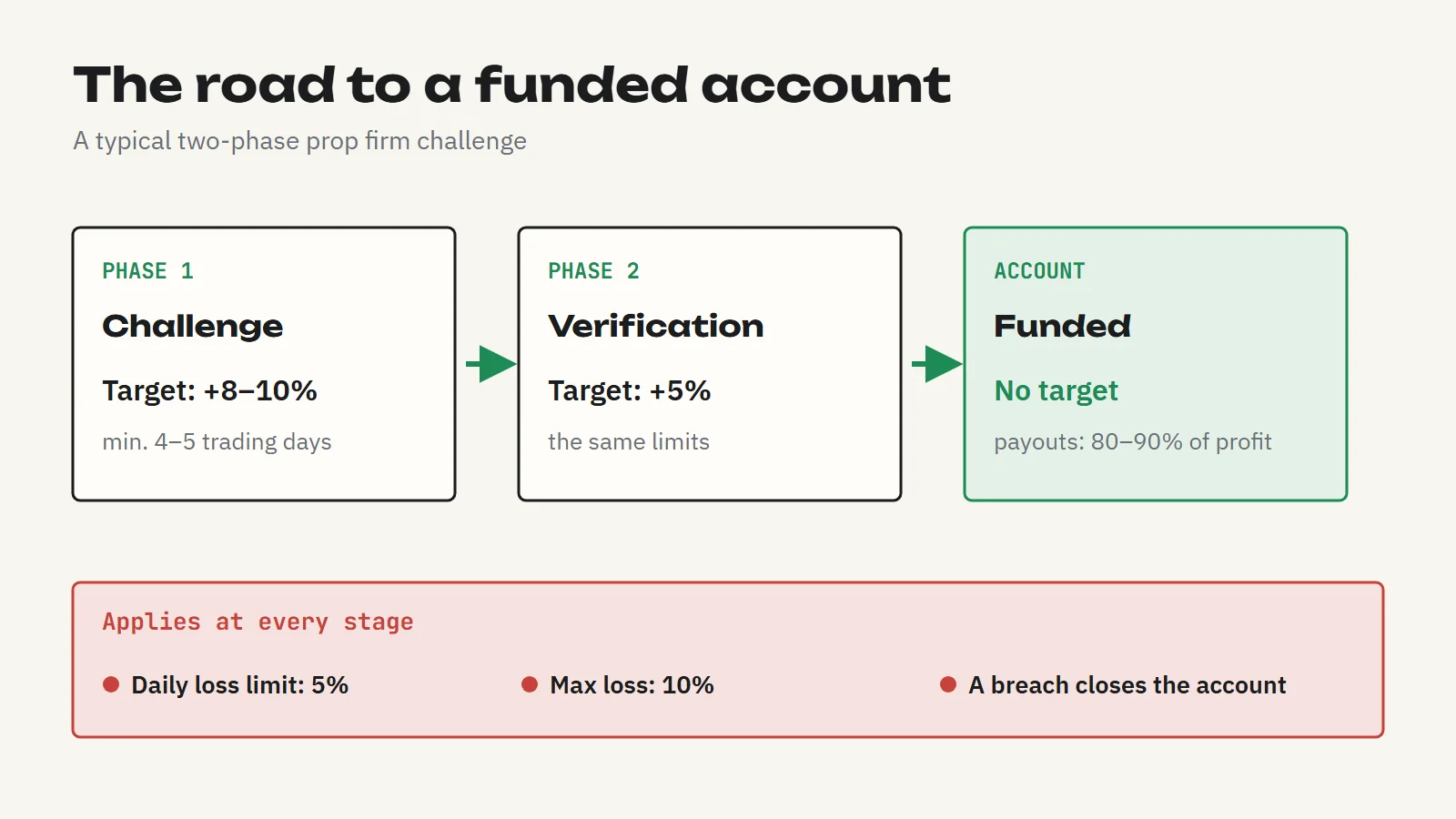
There are also one-step challenges: a single phase with a target of around 10% and tighter limits. Breaking any limit at any stage closes the account, and you have to buy a new challenge.
Prop firm challenge rules: FTMO, FundedNext and the usual terms#
The numbers differ from firm to firm, but the set of rules is almost the same everywhere. Here are two popular two-phase challenges, as published on the firms' official websites in November 2026:
| Rule | FTMO 2-Step | FundedNext Stellar 2-Step | Typical 1-Step |
|---|---|---|---|
| Phase 1 target | 10% | 8% | 10% (single phase) |
| Phase 2 target | 5% | 5% | — |
| Daily loss limit | 5% | 5% | 3–4% |
| Max loss | 10%, static | 10%, static | 6–10%, often trailing |
| Minimum trading days | 4 | 5 | from 2 |
| Time limit | none | none | usually none |
Terms change, and one firm often runs several programs with different rules. Before you buy, check the current rules of your exact program on the firm's website, especially three things: how the daily limit is calculated, whether the max loss trails, and whether a consistency rule applies.
Besides the limits, the rules often include:
- a consistency rule — your best day can't make up more than a set share of the profit. In FTMO's one-step challenge, for example, the best day must stay under 50% of total profit;
- news restrictions — on some programs you can't open or hold trades in the minutes around major releases;
- weekend holding — not allowed everywhere;
- banned strategies — latency arbitrage, hedging across two accounts, copying someone else's signals.
Daily and max drawdown: how they're calculated#
This is the part of the rules that matters most. Most challenges fail here, and often the trader doesn't even realize a limit was breached.
The daily loss limit (daily drawdown) is measured from the balance at the start of the day, not from the starting balance. At FTMO, for example, the floor is reset every day at midnight Central European time: the balance at that moment minus 5% of the initial capital. If a $100,000 account starts the day at $103,800, today's floor is $98,800.
Floating losses count too. The limit is checked against equity, open trades included. A position that dips to −5.1% for a minute and then closes in profit has already broken the rules.
The max loss limit (max drawdown) comes in two kinds:
- static — the floor never moves: on a $100,000 account with a 10% limit it stays at $90,000;
- trailing — the floor rises with the highest balance (often the end-of-day balance) and never comes down. Make it to $104,000 and the floor moves up to $94,000.
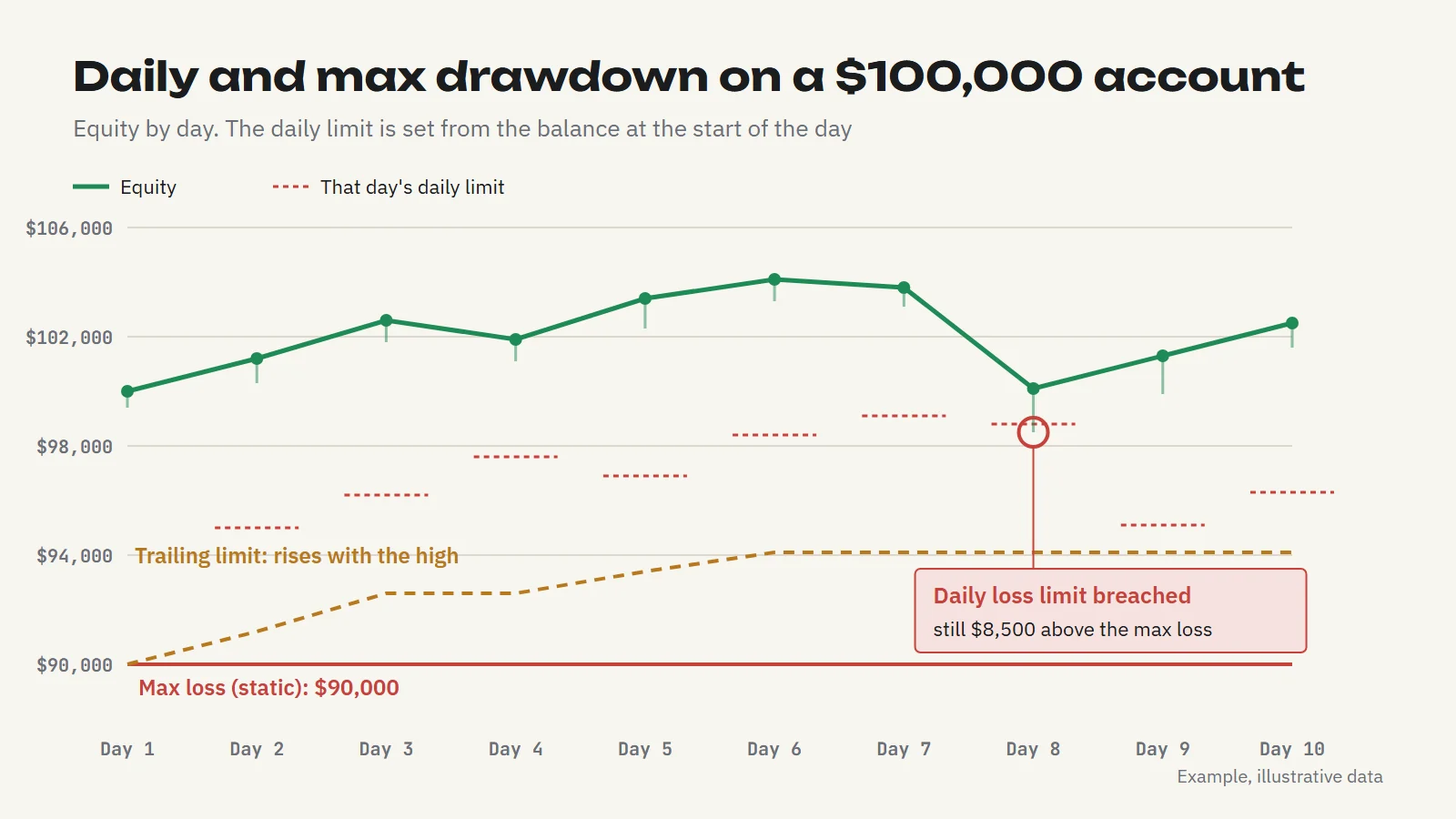
The takeaway: the daily limit is closer than it looks. After a few green days traders look at the room left above the max loss and feel they can take more risk. The rules check the daily floor, which resets from the new balance every day.
How much to risk per trade in a challenge#
Risk per trade decides how many losses in a row you can take before a limit goes. With a fixed risk set from the starting balance the math is simple:
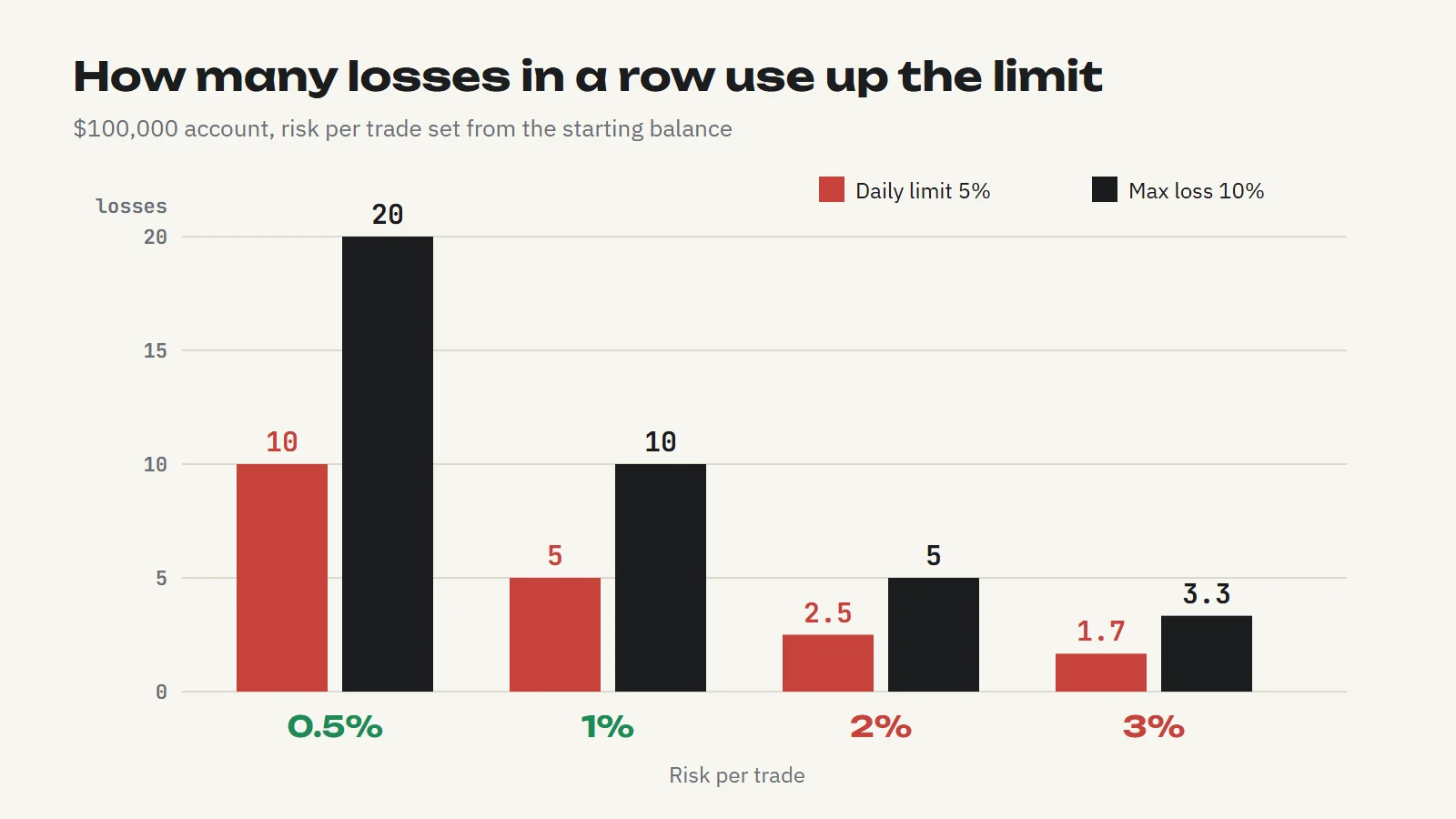
| Risk per trade | Losses to the 5% daily limit | Losses to the 10% max loss | +2R winners to a 10% target |
|---|---|---|---|
| 0.5% | 10 | 20 | 10 |
| 1% | 5 | 10 | 5 |
| 2% | 2.5 | 5 | 2.5 |
| 3% | 1.7 | 3.3 | 1.7 |
Streaks of 4–6 losses happen in good systems too. That is why most traders who pass risk 0.5–1% per trade. At 1% with an average winner of +2R, a 10% target is five net winners, and most challenges no longer have a time limit.
Risking 2–3% "to get there faster" turns the challenge into a lottery: two or three stops in a row and the daily limit is gone. We covered how to work out risk and position size in risk per trade and the R multiple, and you can size the position with the lot size calculator.
What share of traders pass a prop firm challenge#
Prop firms rarely publish exact numbers, so every figure is an estimate. The most common range is 5–15% of traders passing the evaluation. According to FPFX Tech, a technology provider to prop firms, about 14% of more than 300,000 accounts passed a challenge and only about 7% ever reached a payout.
What matters more: most failures are rule breaches, not the lack of a profitable strategy, and the daily limit is the most common one. Your odds depend largely on risk discipline, which is fully in your control.
9 mistakes that fail prop firm challenges#
- Oversized risk to reach the target faster. At 2–3% per trade the daily limit goes after 2–3 stops.
- Floating losses past the daily floor. A trade with no stop, or a wide one, pierces the daily limit on equity for a minute, and the account is closed even if price turns around later.
- Revenge trading after a loss. After two stops the risk goes up and the setup standards go down. That's classic tilt; read more in tilt in trading.
- Getting the daily limit wrong. The trader counts it from the starting balance while the firm counts it from the day's starting balance, or the other way round. A few hundred dollars decide everything.
- Trading the news without checking the rules. Some programs ban trades around major releases, and news spreads and slippage easily touch the daily limit.
- Holding over the weekend where it's not allowed, or weekend gaps that open past the stop.
- Ignoring the consistency rule and the minimum days. The target is hit in one day, but the phase doesn't count because the best day was too large a share of profit or there weren't enough trading days.
- Switching strategies mid-challenge. A new system "because the old one isn't working today", with no stats and no testing.
- No trading journal. Without records you can't tell which trade and which decision broke the account, and the next challenge repeats the same mistakes.
A step-by-step plan to pass a prop firm challenge#
Before you buy:
- Read the rules of your program: target, daily and max loss and how they're calculated, minimum days, news, weekends, consistency.
- Test the strategy on history or on demo: average win and loss in R, win rate, the longest losing streak.
- Pick an account size you're comfortable with. Losing $100,000 "on paper" is harder than it sounds.
During phase 1 and phase 2:
- Risk 0.5–1% per trade, with a personal daily stop below the firm's limit: for example, −2% or two losses in a row and you're done for the day.
- Set the stop loss on every trade as you enter, so a floating loss can't touch the daily floor.
- Track progress in R, not dollars: a 10% target at 1% risk is +10R.
- At the end of each day, check how much room is left to the daily and max loss limits.
On the funded account:
- Change nothing: the limits are the same, and the urge to risk more after the first payout is the most dangerous moment.
How a trading journal helps you pass#
Limits are easy to break while they live in your head. It's much easier when the room left to each limit is in front of you before every trade, and every mistake is logged with its cost in R and percent. We covered what to record in how to keep a trading journal.
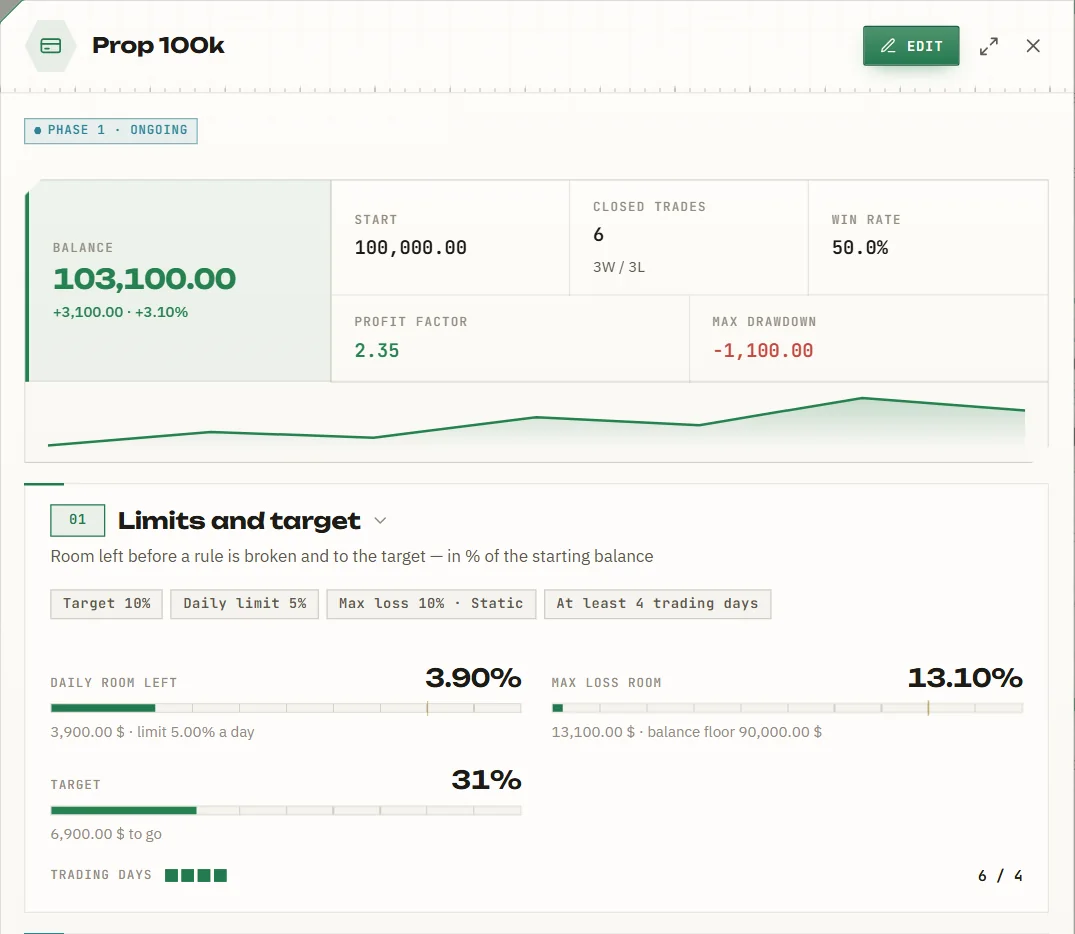
In FINTRIX LAB a prop account carries its challenge rules: target, daily and max loss (static or trailing) and minimum trading days. The journal works out how much room is left to each limit and to the target, warns you when a trade brings you close to a limit, and counts your trading days. If you trade one idea on several prop accounts, you log the trade once and copy it to the others. Sign-up is free, no card needed.
This article is not investment advice. Trading financial markets carries a risk of losing money. FINTRIX LAB is not affiliated with FTMO, FundedNext or any other prop firm mentioned here; the names are used only to describe their terms.
FAQ#
What's the difference between phase 1 and phase 2?
Usually just the target: 8–10% in phase 1, 5% in phase 2. The loss limits and restrictions are the same. Phase 2 exists so the firm can see that phase 1 wasn't luck.
What happens if I break the daily loss limit?
The account is closed on the spot, even if you were one trade from the target. The challenge fee isn't refunded, and a new attempt has to be bought. Some firms offer a discount on a retry, but the challenge starts from zero.
Do floating losses count toward the daily limit?
At most firms, yes: the limit is checked against equity, open trades included. That's why the stop loss goes in as you enter, not "once it's clearer".
What is a trailing drawdown?
A max loss limit that rises with the highest balance or equity and never comes down. On a $100,000 account with a 10% trailing limit, a climb to $105,000 moves the floor to $95,000. A static limit would have stayed at $90,000.
Do prop firms refund the challenge fee?
Many firms refund the fee with your first payout on the funded account, but not all of them and not on every program. Check the terms of your exact program before you buy.
Can I trade several prop accounts at the same time?
Yes, many traders do, within each firm's cap on total allocation. The key is to track each account separately: its own limits, its balance at the start of the day and its results.